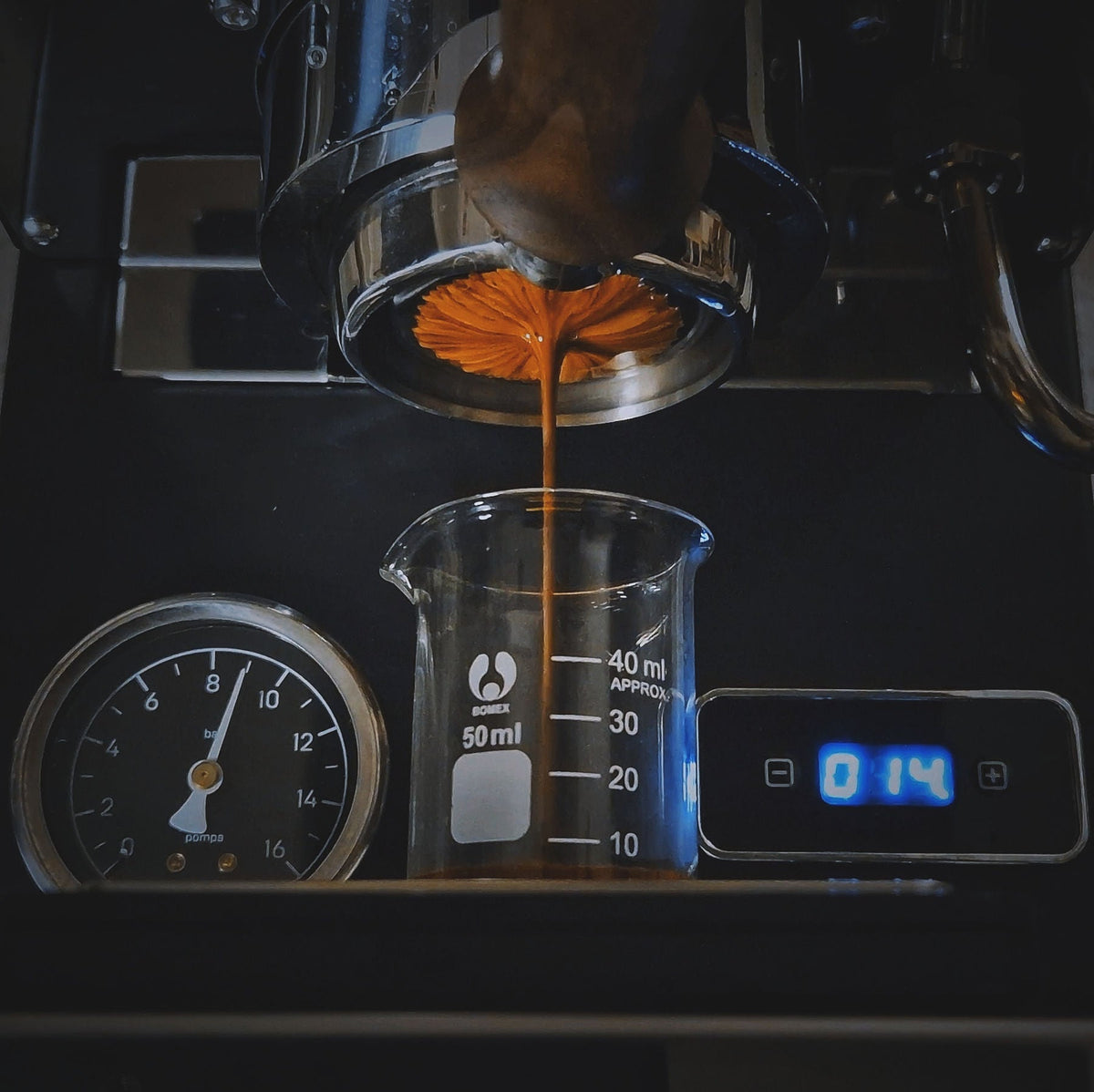
Classification: What is a PID control in espresso machines?
A PID control electronically stabilizes the brewing temperature of your espresso machine. The abbreviation PID stands for Proportional-Integral-Derivative and describes a control algorithm that doses the heating power in such a way that the target temperature is achieved and maintained as precisely as possible. As a result, precise PID control improves espresso consistency, reproducibility, and shot quality – especially with lighter roasts, which are very sensitive to temperature fluctuations.
While classic household machines work with a thermostat or pressurestat, an espresso machine with PID uses sensor technology and electronics for delicate control. This reduces fluctuations during extraction and between extractions (recovery), which is a noticeable gain for demanding home baristas and offices.
How PID works: Temperature control simply explained
Interaction of sensor technology, control algorithm, and heating power
The core is a temperature sensor (usually a thermistor or thermocouple) in the boiler or thermoblock. It continuously provides measured values to the PID controller. The controller calculates the necessary heating power from three components:
- Proportional component: Reacts immediately to the current deviation from the target temperature.
- Integral component: Corrects long-term, small deviations (drift) and ensures that the target temperature is actually reached.
- Differential component: Dampens overshoot by taking into account the rate of change.
The heating is typically controlled via a Solid-State Relay (SSR) or PWM. This allows the heating power to be finely adjusted in steps – minimizing temperature fluctuations and keeping the brewing temperature tightly within the target corridor. In practice, this means: less guesswork, less bitterness due to overheating, and more clarity in the cup.
PID vs. Pressurestat: Differences in stability and comfort
A pressurestat switches the heating on/off based on the boiler pressure. This is robust and sufficient for steam and hot water – in heat exchange machines, the brewing temperature results from the heat exchanger. A PID, on the other hand, measures the temperature directly (or close to it) and regulates continuously. Advantages:
- Higher temperature stability for espresso (lower fluctuations).
- Finely adjustable: Target temperature in 0.5–1 °C increments.
- Comfort: Display, possibly profiles, timer, and app control.
A classic pressurestat scores with simplicity and longevity. However, those who want reproducible results and precise espresso temperature control will benefit significantly from PID. In the PID vs. pressurestat trade-off, the decision often depends on how sensitive you are to consistent brewing temperatures and whether you enjoy experimenting.
Advantages and disadvantages: Is PID really worth it?
Constant brewing temperature, reproducibility, shot quality
- Espresso temperature stability: Less overshoot/undershoot before and during extraction.
- Reproducibility: Settings remain traceable, ideal for recipe development.
- Shot quality: Better sweetness, clarity, and balance – especially with light and medium roasts.
- Efficiency: Faster recovery, shorter waiting times between shots (model-dependent).
- Transparency: Display shows status; changes are immediately and measurably traceable.
Potential weaknesses: Electronics, maintenance, costs
- Electronics are more sensitive than pure mechanics; professional service is important.
- Slightly higher initial purchase costs; repairs can be more expensive.
- Operating concept: Too many options can initially overwhelm beginners.
- Sensor position and offset: Calibration may be necessary depending on the machine.
Conclusion: For most coffee connoisseurs, an espresso machine with PID is worthwhile if consistency and fine-tuning are important. Those who prefer a purist, low-maintenance machine might still be happy with a solid pressurestat system.
Practical benefits: Which settings lead to better shots?
Start temperature, offset, and recovery in single-boiler/dual-boiler machines
The PID target temperature is not always identical to the actual brewing temperature at the puck. Reason: Sensor position (boiler, thermoblock, group) and heat loss. Therefore, many manufacturers define an offset. Proceed as follows:
- Start with the manufacturer's suggestion (e.g., 93 °C) and standard offset.
- Adjust in 0.5–1 °C increments until sweetness/clarity increase and bitterness/acidity are balanced.
- Check recovery: Test consecutive extractions. If shot 2/3 is too hot/cold, slightly correct the PID target temperature or adjust the waiting time between shots.
Single-boiler PID: When switching between steam and extraction, temperature peaks occur. After frothing, vent the machine, let the temperature stabilize briefly, and possibly go 0.5–1 °C lower to avoid overshoot.
Dual-boiler PID: Separate brew boiler ensures high stability; recovery is usually excellent. Here, it can be finely combined with temperature profiles or pre-infusion.
Heat exchange PID (HX): A PID usually controls the steam boiler; the brewing temperature results from the heat exchanger and flush routines. A PID helps with consistency but still requires sensible cooling flushes depending on the machine.
Recipes for roast levels: light, medium, dark
Practical starting points are:
- Light roast: 93–95 °C, often 94–95 °C for more extraction and sweetness.
- Medium: 92–94 °C, often 93 °C as a good compromise.
- Dark: 90–92 °C, to avoid bitterness and emphasize body.
Fine-tuning: Change the temperature gradually. If the shot is flat and sour, go a little higher; if it tastes bitter and heavy, lower it by 0.5–1 °C. Note: Grinder, bean age, and recipe (e.g., 1:2 in 25–30 s) strongly influence the result – the PID is a tool, not a magic switch.

Who is PID suitable for? Home barista, office, gastronomy
- Home barista: Ideal for developing recipes, changing beans, and still achieving reproducible results. A single-boiler with PID may suffice; those who often prepare milk drinks benefit from a heat exchange PID or dual-boiler PID.
- Office: Consistency despite changing users. Display and fixed presets simplify operation. A dual-boiler with PID and shot timer offers comfort and throughput.
- Gastronomy: For high volumes, robust dual-boilers with PID, stable group, and service access are useful. Temperature profiles can support the variety of the espresso menu.
- Single-boiler PID: Compact, inexpensive, very good for espresso purists. Milk drinks are possible but require switching and routine.
- Heat exchange PID: Steam power and extraction possible in parallel. PID stabilizes boiler pressure, but flush routines are sometimes necessary.
- Dual-boiler PID: Maximum control and stability; ideal if you frequently prepare several drinks in a row or want to experiment with temperatures.
- Display: Easy to read, fast step size (0.5–1 °C), shot timer helpful.
- App/Connectivity: Convenient for saving profiles/presets; pay attention to updates.
- Profiles: Gentle ramp-up, flat or decline profiles can offer advantages depending on the bean (model-dependent).
- Comfort: Programmable button for flush/boost, pre-infusion (time or pressure-based), sleep mode.
- 230 V – Work only by qualified personnel; strictly adhere to safety standards.
- Warranty may be voided; check manufacturer conditions.
- Carefully plan space, cable routing, and heat dissipation.
- Overshoot/oscillation: P/I/D values are factory-optimized; if adjustable, change only minimally. Check descaling and sensor seating.
- Incorrect display: Sensor corroded/loose. Check contact, replace sensor if necessary. Check offset.
- Sluggish recovery: Insulate boiler (if possible), adjust idle times, optimize extraction pre-infusion.
- SSR defective (always on/never on): Have a specialist replace it. Prevention: adequate cooling and correct specification.
- Inconsistent results despite stable display: Cause often at the puck. Check grind size, distribution, tamping, basket size, and water flow rate.
- Model changes and trade fairs: Often in autumn/winter – good time for new products or clearance sales.
- Promotional days: Black Friday and the beginning of the year often bring bundles of espresso machine plus grinder.
- Upgrade strategy: First invest in a good grinder, then the machine. The grinder influences the cup at least as much as a PID.
- Water on the agenda: Purchase filtration/softening – stabilizes sensor technology and reduces maintenance effort.
- Precision thermometer or brew group thermometer for checking the offset.
- Precisely fitting baskets (ridged/ridgeless), bottomless portafilter for diagnosing the puck.
- Weight tamper/leveler for even extraction.
- Cleaning: Blind basket, coffee detergent, group brush; regular backflushing.
Buying Guide: What to look for in a PID espresso machine
Single-boiler, heat exchange, dual-boiler – with and without PID
Important: Sensor position, thermal mass of the brew group (E61 vs. saturated group), heat-up time, and service access. Look for good insulation, a quiet pump, solid valves, and available spare parts.
Operating concepts: Display, app, temperature profiles
Retrofitting: Possibilities, risks, warranty issues
Retrofitting PID to an espresso machine: For some machines, retrofit kits are available. These include sensor, controller, SSR, and brackets. Advantages: Gain precision without replacing the machine. Risks:
Tip: Use expert advice and installation. Kaffanero supports you in selecting compatible machines and kits or recommends an espresso machine with PID ex-works.
Maintenance and troubleshooting: Solving typical PID problems
Regularly backflush, descale (according to water hardness plan), maintain seals and valves. Protect electronics from moisture.
Seasonal tips: Purchase times, offers, planning upgrades
Product Recommendations
PID-enabled espresso machines and suitable grinders at Kaffanero
For espresso enthusiasts focusing on temperature stability, we recommend compact single-boiler PIDs as an entry point, dual-boiler PIDs for maximum control, and selected heat exchange PIDs for strong steam plus solid espresso performance. Combine your machine with a precise espresso grinder with micrometric adjustment. We will be happy to advise you and put together suitable pairs – tailored to beans, budget, and space.
Accessories: Precision thermometer, baskets, tamper, cleaning
If you are unsure which combination makes sense for your daily routine, a short consultation will help – without pressure, but with practical recommendations.